Strength Training for Sarcopenia: What Trials Show
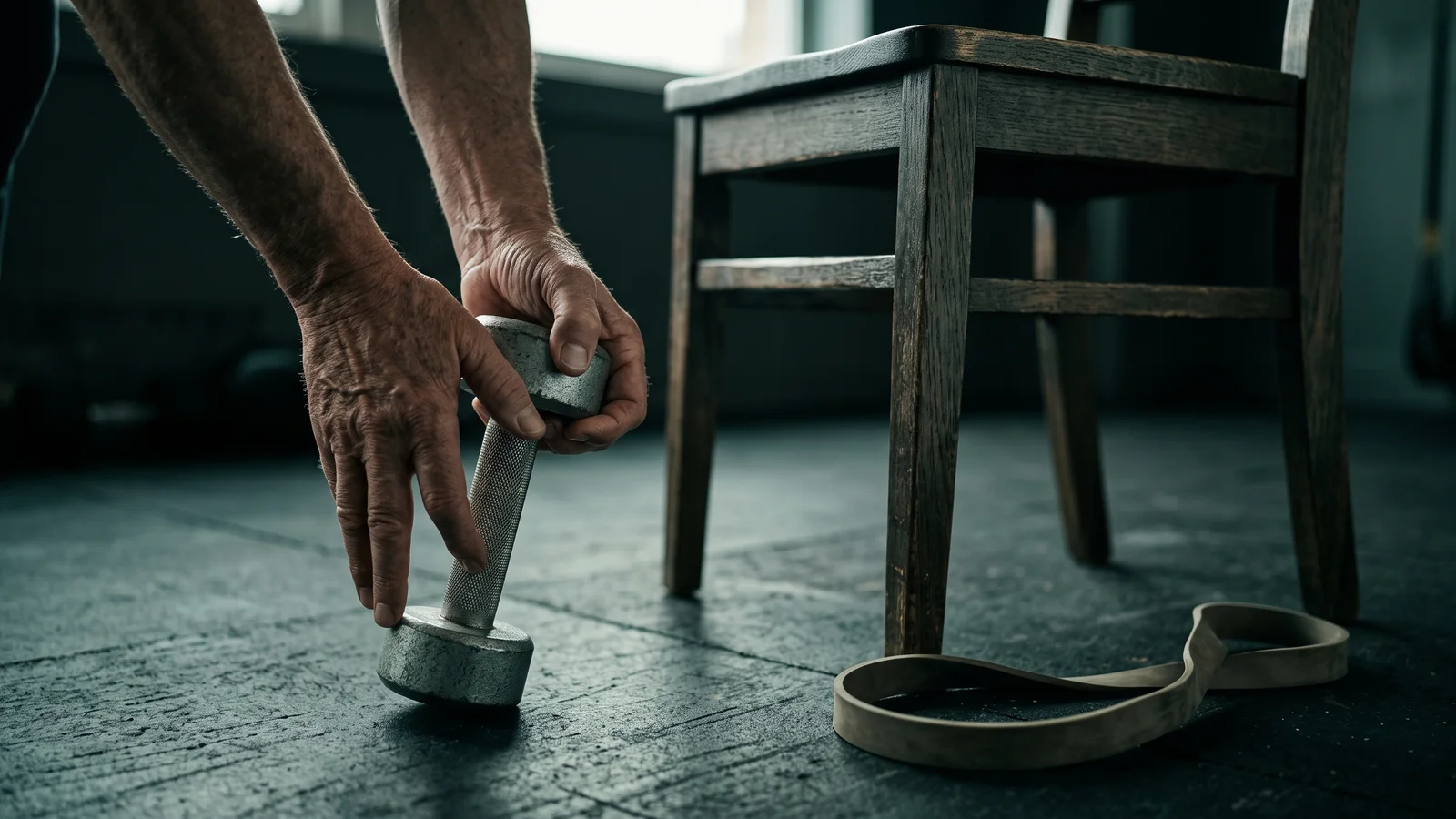
Resistance training reliably improves strength, grip and walking ability in older adults with sarcopenia, but the evidence for building measurable muscle mass is weaker and more mixed. Two recent meta-analyses of randomized trials point the same way on function, and they offer useful but cautious hints about how often and how hard to train.
Sarcopenia is the age-related loss of muscle strength and mass that makes stairs, carrying shopping and getting up from a chair harder. This guide summarizes what the newest reviews found, where the evidence is thin, and how to turn it into a sensible weekly plan. It is general education, not medical advice; anyone with a diagnosed condition should check with a clinician before starting.
What sarcopenia is and why it matters
Sarcopenia describes the gradual decline in skeletal muscle strength, mass and physical performance that tends to accompany ageing. It is not simply being small or thin. A person can carry plenty of body fat and still have too little functional muscle, which is why researchers measure grip strength, walking ability and chair-rise performance alongside body composition. These everyday tasks are what determine whether someone can keep living independently.
The decline is driven by several things at once: less physical activity, changes in how muscle responds to protein and exercise, hormonal shifts, illness, and sometimes too little food. Because so many causes overlap, no single fix exists. Exercise, particularly resistance training, is the intervention with the most consistent trial support, which is why systematic reviews keep returning to it and why the question has moved from whether to train to how to train.
It also helps to know how these studies are built. Most trials enroll people who already meet a sarcopenia definition, then compare a supervised strength programme with usual activity or a lighter control. They run for weeks to a few months, not years. That design tells us a lot about short-term functional gains, and much less about long-term outcomes such as falls, fractures or independence, which need larger and longer studies.
What the 2026 meta-analysis found
A 2026 systematic review and meta-analysis in the European Review of Aging and Physical Activity, led by Zhiyuan Tan and colleagues, pooled 25 randomized controlled trials with 1,302 participants. Resistance training produced a pooled effect size of 0.71 for muscle strength, 0.55 for grip strength and 0.41 for walking ability. Those are meaningful improvements in the things that matter day to day, and they appeared across a range of programmes.
Body composition changed more modestly. Lean mass improved with an effect size of 0.22, while fat mass moved in the favourable direction with an effect size of minus 0.17. Both numbers are small compared with the strength results, which fits a common pattern in older adults: the nervous system and muscle quality adapt quickly, while measurable tissue growth is slower and harder to detect with standard scans.
The authors also estimated how much total training time seemed linked to the biggest gains, and they were explicit that these are exploratory indicators rather than prescriptions. They examined age and intensity as moderators and noted heterogeneity in protocols and in how sarcopenia was diagnosed. Publication bias was detected for several outcomes, so the true effects may be somewhat smaller than the pooled figures suggest, and readers should weigh them with caution.
Dose, frequency and exercise choice
A separate 2025 meta-analysis in BMC Geriatrics, by Jianxin Ran and colleagues, looked specifically at dose and response across 12 trials with 538 participants. It found moderate benefits for grip strength, with a standardized mean difference of 0.63, and for performance on the Short Physical Performance Battery, at 0.56. Programmes typically used two to three sets of eight to fifteen repetitions per exercise and ran from 8 to 26 weeks.
The frequency finding surprised some readers. Training twice a week showed a significant benefit for grip strength, while three times a week did not significantly improve it in this analysis. That does not prove that more is worse; the subgroups were small and the trials differed in many other ways. A fair reading is that two well-executed sessions per week can be enough to start, and that more is not automatically better.
The same review reported that moderate intensity outperformed moderate-to-vigorous intensity for grip strength, and that programmes including pulling movements such as lat pulldowns, seated rows or deadlift variations did better on grip outcomes. The authors rated the overall evidence quality as low, citing few trials and uncontrolled differences in training variables. Treat these as promising hints for planning, not firm rules that apply to everyone.
Where the evidence is weaker
The clearest caveat is muscle mass. In the 2025 review, the improvement in skeletal muscle mass index was not statistically significant, with a confidence interval that crossed zero. In the 2026 review lean mass did improve, but only slightly. Taken together, the honest summary is that strength and function respond more reliably than scan-measured muscle size, so judging progress by the scale or a body-composition report alone may be misleading.
Study quality matters too. The 2026 authors noted incomplete allocation concealment and limited blinding in several trials, small samples within each intensity category, and inconsistent reporting of adverse events. Exercise trials can never be fully blinded, which tends to flatter the results slightly. Muscle quality, one of the largest effects reported, came from only two studies and should be treated as a signal worth testing, not a settled finding.
Finally, these trials are mostly short and supervised. People in a research programme receive coaching, scheduling and encouragement that many do not have at home. Whether the same gains persist when supervision ends, and whether they translate into fewer falls or fractures, is not answered by these reviews. That is a reason to build habits that can be sustained rather than to chase the most aggressive protocol available.
Turning the research into a weekly plan
A practical starting point consistent with the trials is two or three full-body sessions per week, built around a handful of compound movements: a sit-to-stand or squat pattern, a push, a pull, and a hip hinge or step-up. Use two to three sets of eight to fifteen repetitions, leave a few repetitions in reserve at first, and increase load gradually as technique and confidence improve. The World Health Organization also publishes physical activity guidelines that cover older adults.
Food supports the training. The International Society of Sports Nutrition's 2017 position stand notes that older adults may benefit from larger servings of high-quality protein, around 40 grams per meal for some, though individual needs differ and people with kidney disease or other conditions should take medical advice. Distributing protein across meals is covered in our protein distribution guide, and total intake is worth discussing with a dietitian if appetite is low.
Safety and progression matter more than ambition. Begin with loads that feel manageable, use machines or supported variations if balance is a concern, and stop and seek advice for chest pain, dizziness or joint pain that persists. Track what you can see: chair-rise time, walking speed, the weight you can lift for ten repetitions. Those are the outcomes the trials show improving, and they are the ones that matter most for daily life.
Sarcopenia-friendly strength checklist
- check_circleCheck in first — talk to a clinician if you have a heart, joint or balance condition before starting.
- check_circleTrain two to three times a week — full-body sessions with a rest day between them.
- check_circleChoose five core movements — squat or sit-to-stand, push, pull, hinge or step-up, and a carry.
- check_circleUse 2–3 sets of 8–15 reps — a range typical of the trials, with moderate effort at first.
- check_circleInclude pulling exercises — rows and pulldowns were linked to better grip outcomes.
- check_circleTrack function, not just size — note chair-rise time, walking speed and grip.
- check_circleEat enough protein at each meal — and review total intake with a professional if appetite is poor.
"In older adults, the most dependable payoff from lifting is function: stronger grip, steadier walking and easier daily tasks. Visible muscle growth is a bonus, not the measure of success."
— Calorie Fit Editorial Team
Frequently Asked Questions
Does resistance training reverse sarcopenia?
Trials show it improves strength, grip and walking performance, but the effect on measured muscle mass is smaller and less consistent. Training is best seen as a way to slow decline and improve function, not as a guaranteed reversal.
How often should an older adult lift weights?
Reviews include programmes of two to three sessions per week, and one 2025 analysis found two sessions already helped grip strength. Starting with two quality sessions and adding a third as recovery allows is a reasonable approach.
Is it too late to start strength training at 70 or 80?
The trials enrolled older adults with sarcopenia and still found improvements in strength and function over weeks to months. Starting later does not rule out benefit, but a medical check and gradual progression are sensible.
Do I need heavy weights to see benefit?
Not necessarily. One review found moderate intensity did better than moderate-to-vigorous intensity for grip strength, and another examined a wide range of intensities. Consistency and good technique matter more than maximal loads.
Sources
- Optimizing prescription of resistance training for body composition, muscle strength, and physical performance in older adults with sarcopenia: a systematic review and meta-analysis — European Review of Aging and Physical Activity, 2026
- Dose-response effects of resistance training in sarcopenic older adults: systematic review and meta-analysis — BMC Geriatrics, 2025
- WHO guidelines on physical activity and sedentary behaviour — World Health Organization, 2020
- International Society of Sports Nutrition Position Stand: protein and exercise — Journal of the International Society of Sports Nutrition, 2017
Educational information, not medical advice. See our Medical Disclaimer and Editorial Policy for how we research and verify articles.