HRV Training: How Heart Rate Variability Transforms Athletic Performance
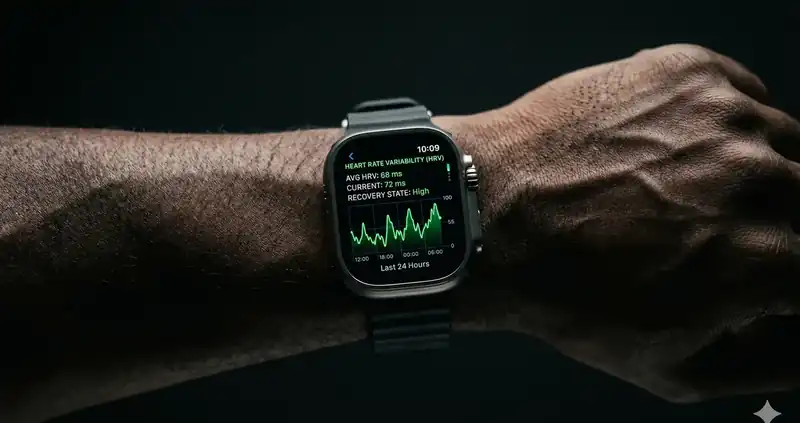
Most athletes track the wrong things. They count sessions per week, miles logged, weight lifted, and calories burned. What they rarely measure is how ready their body actually is to absorb the next training stimulus. Heart rate variability — the millisecond variation in time between consecutive heartbeats — is the single most informative metric for answering that question. It is not a number on a wearable to gamify. It is a direct readout of your autonomic nervous system status, and learning to read it correctly will make every hour you train more effective.
What HRV Actually Measures
Your heart does not beat with a perfectly regular rhythm like a metronome. Even at rest, the gap between beats fluctuates by milliseconds. This variation is controlled by the autonomic nervous system — specifically the balance between the sympathetic branch (fight-or-flight, activation, stress) and the parasympathetic branch (rest-and-digest, recovery, restoration). High HRV means the two systems are in dynamic balance, with the parasympathetic branch dominant — the physiological state associated with readiness, recovery, and adaptation. Low HRV means the sympathetic system is dominant: your body is under stress, whether from hard training, illness, poor sleep, alcohol, or psychological pressure.
The standard HRV metric reported by wearables is RMSSD — the root mean square of successive differences between R-R intervals. It captures beat-to-beat variability in a way that reflects parasympathetic activity. Elite endurance athletes typically show RMSSD values of 80–120ms at rest. Sedentary individuals often sit at 20–40ms. Both ends of the spectrum are heavily influenced by age, genetics, training history, and measurement conditions, which is why absolute numbers matter far less than your personal baseline trend.
Why Athletes Should Care About HRV
The case for HRV-guided training comes from a body of research showing that athletes who adjust training intensity based on daily HRV readings outperform those who follow a fixed programme. A landmark 2014 study by Kiviniemi et al. found that HRV-guided training produced significantly greater improvements in VO2 max and running performance compared to a traditional periodised plan, with lower incidence of non-functional overreaching. The key insight: the body does not adapt to training during the session. It adapts during recovery. If recovery is incomplete — shown by suppressed HRV — adding more load does not add more adaptation. It adds more fatigue on top of residual fatigue.
Professional sports teams have used HRV monitoring for over a decade. The All Blacks rugby team, numerous Premier League football clubs, and Olympic coaches in cycling and swimming use HRV to guide training load decisions at the individual level. The technology and the research have now trickled down to consumer wearables affordable enough for any serious recreational athlete.
"HRV-guided training produced greater VO2 max gains and performance improvements than a traditional periodised programme, with fewer overtraining incidents."
— Kiviniemi et al. (2014), International Journal of Sports Physiology and Performance
How to Measure HRV Correctly
The most accurate consumer HRV measurement comes from a chest-strap heart rate monitor (Polar H10 is the research standard) paired with an app that captures raw R-R intervals. Optical wrist-based sensors (Apple Watch, Garmin, Oura Ring, WHOOP) are less accurate but sufficiently reliable for trend tracking in most users. Regardless of device, measurement protocol consistency is what matters most.
Measure first thing in the morning, before getting out of bed, after at least 5 minutes of lying still. Measure for at least 60 seconds — 3–5 minutes is better. Any deviation from this protocol — sitting up, checking your phone, drinking coffee first — will shift the reading. Your HRV score is meaningless in isolation; it is the rolling 7-day average and daily deviation from that average that carries actionable signal. Most apps (Elite HRV, HRV4Training, Oura, WHOOP) calculate this automatically.
Reading Your HRV: Green, Amber, Red
Green — HRV at or above your baseline
Proceed with planned training, including high-intensity work. Your autonomic nervous system is recovered and primed to absorb a hard stimulus. This is the day to hit your intervals, lift heavy, or do your longest session of the week.
Amber — HRV 5–10% below your baseline
Proceed with caution. Reduce planned intensity by 10–20%. Convert a scheduled interval session to Zone 2. Do not skip training entirely — movement helps restore HRV — but avoid pushing to maximum effort on a suppressed system.
Red — HRV 10%+ below baseline, or 5+ consecutive low days
Active recovery or full rest only. Five or more consecutive days of suppressed HRV is a clinical overtraining warning sign. Investigate the cause: sleep quality, training load, nutrition deficit, illness, life stress. Pushing through will deepen the hole.
What Suppresses HRV (Beyond Training)
Training load is just one of the inputs that shifts HRV. Alcohol consumption suppresses HRV for 24–48 hours after even moderate intake — two drinks the night before will reduce your morning reading regardless of how well you slept. Poor sleep quality (not just duration) dramatically lowers HRV; REM sleep in particular is when parasympathetic recovery is deepest. Psychological stress — a difficult week at work, a relationship conflict, financial anxiety — activates the sympathetic nervous system and suppresses HRV just as meaningfully as a hard training session.
This multi-input sensitivity is actually HRV's greatest strength as a metric. It aggregates all stress — physical, psychological, and biochemical — into a single number. A low HRV on a rest day is not caused by training. It is telling you that something else in your life is consuming recovery capacity. Treating that information seriously and adjusting your training response accordingly is what separates athletes who progress consistently from those who cycle through periods of great form and unexplained fatigue.
How to Improve Your HRV
HRV is trainable. The interventions with the strongest evidence are: consistent aerobic training (particularly Zone 2 cardio — see our Zone 2 guide), quality sleep of 7–9 hours, nasal breathing during rest and light exercise, slow diaphragmatic breathing practices (5–6 breaths per minute), cold water exposure, and reduced alcohol intake. Magnesium glycinate supplementation (200–400mg before bed) has shown consistent HRV benefits across several studies, likely via improved sleep quality.
Controlled breathing exercises — specifically resonance frequency breathing at around 5.5 breaths per minute — directly stimulate the vagus nerve and have been shown in clinical trials to raise resting HRV by 15–25% over 6–8 weeks of daily practice. The practice takes less than 10 minutes and can be done anywhere. Apps like Elite HRV, Breathwrk, and Othership guide resonance breathing sessions with biofeedback.
HRV and Nutrition Timing
Caloric deficit suppresses HRV. Athletes cutting weight aggressively — beyond 500 kcal/day deficit — will see HRV decline as the body interprets energy scarcity as systemic stress. This is one of the physiological mechanisms behind reduced performance during cuts. Use our TDEE Calculator to set a moderate, sustainable deficit (300–500 kcal) that preserves training quality and keeps HRV from crashing. Large overnight carbohydrate meals before a hard training day have also been shown to attenuate the HRV suppression caused by glycogen depletion, supporting both overnight recovery and morning readiness scores.
Protein adequacy matters too. Underfeeding protein relative to training volume increases muscle protein breakdown markers and amplifies the recovery debt that suppresses HRV. Maintaining 1.6g of protein per kilogram of bodyweight supports tissue repair during high-volume blocks and keeps your HRV baseline from drifting downward over a training cycle. Use the Macro Calculator to set your protein floor before adjusting other macros.
Frequently Asked Questions
What is a good HRV score for my age?
Population averages decline with age: ages 20–25 average around 65–75ms RMSSD; ages 40–45 around 45–55ms; ages 60+ around 25–40ms. However, trained athletes at any age typically sit 15–25ms above the sedentary average for their age group. Your personal baseline trend matters far more than comparison to population averages — focus on improving your own number rather than chasing a benchmark.
Can I use my Apple Watch or Garmin for HRV?
Yes, with caveats. Optical wrist sensors are 10–20% less accurate than chest-strap ECG sensors for individual beat detection, but their trend data is reliable enough for training decisions. The key is consistency: use the same device, same measurement position, same time of day every day. Do not switch devices mid-season — the absolute values will differ even if both devices are technically accurate.
Should I always rest when my HRV is low?
Not always — context matters. A single low reading warrants caution (reduce intensity) but not necessarily full rest. Five or more consecutive low readings, or a reading more than 20% below your baseline, warrants genuine recovery. Light aerobic movement (Zone 1 walk, easy cycle) actively promotes HRV recovery and is preferable to total inactivity unless you are ill or injured.
Does HRV increase as you get fitter?
Yes, and this is one of the most tangible markers of aerobic adaptation. As cardiovascular fitness improves — particularly through consistent Zone 2 training — resting heart rate drops and parasympathetic tone increases, both of which raise HRV. Most untrained individuals who begin consistent aerobic training see HRV improvements of 15–30% within 12 weeks. Elite endurance athletes have some of the highest recorded resting HRV values of any demographic.
Does alcohol really affect HRV that much?
Yes — more than most athletes realise. A 2021 study in JMIR Mental Health found that even moderate alcohol consumption (2–3 standard drinks) suppressed HRV by an average of 22% the following morning. The effect scales with consumption and persists for 24–48 hours. An athlete who drinks on Friday evening and measures HRV Saturday morning may see their lowest reading of the week, regardless of how well they slept or how easy their Friday training was.
What is the best free app for HRV tracking?
HRV4Training is the most research-validated consumer app, developed by exercise science PhDs and requiring only your phone's camera (no wearable needed — it uses photoplethysmography via the rear camera). Elite HRV is the best free option for chest-strap users and has a clean interface for trend tracking. Both apps calculate your rolling baseline and give colour-coded daily recommendations, making the data immediately actionable without requiring deep expertise.